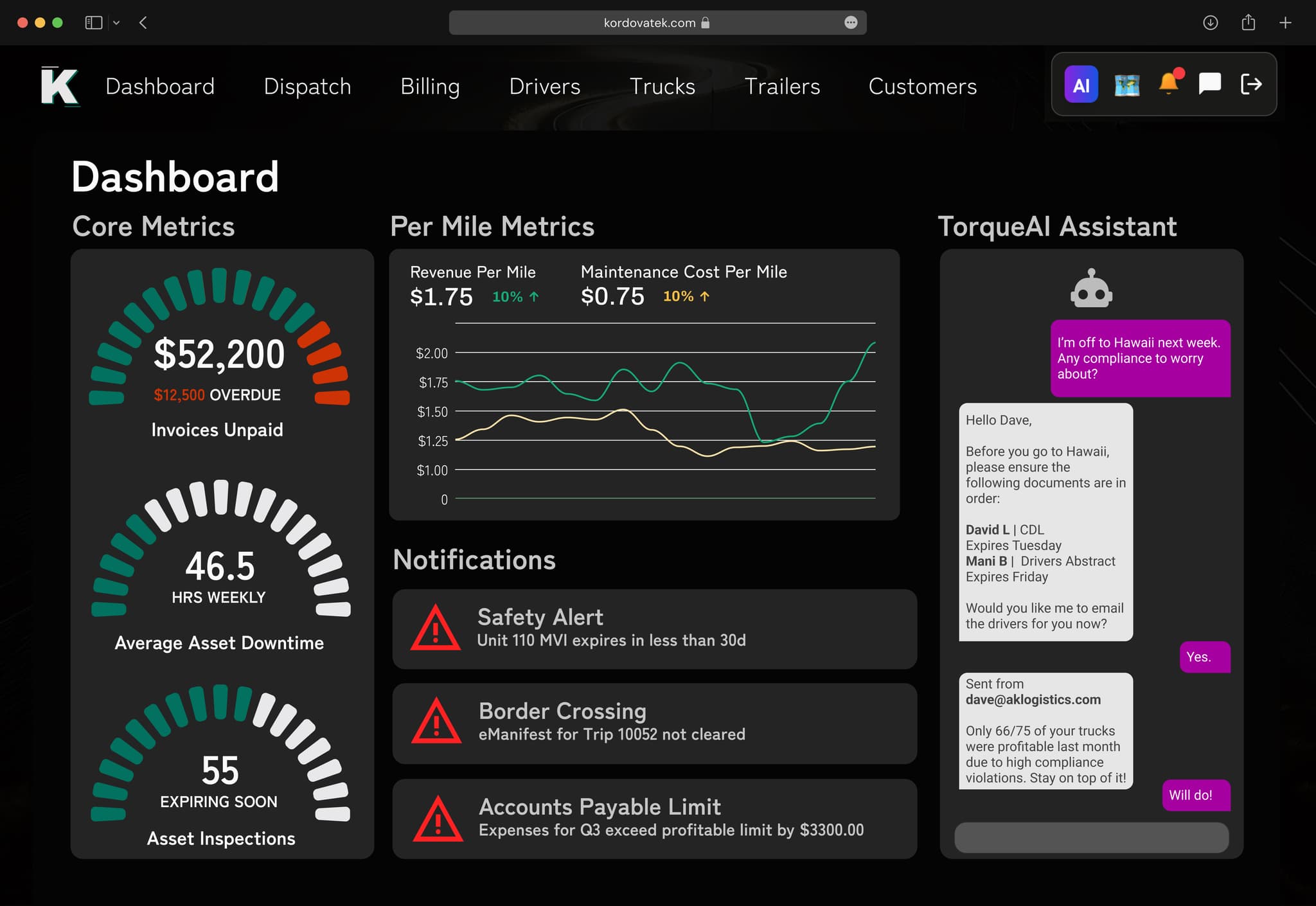
A growing fleet needs a TMS that keeps several people on the same page. Past 25 trucks, the pain is not typing. It is that three dispatchers, a biller, and an owner all have a different picture of the operation. TorqueAI puts everyone in one live system and shows profit per truck and lane as it happens.
When the second and third dispatcher make things worse
You hired another dispatcher to take pressure off. For a few weeks it worked. Then the cracks showed up.
Two dispatchers promised the same truck for Thursday. A driver got told one pickup time by one person and a different one by another. A load got delivered but never billed, because each person thought the other had sent the invoice.
Driver chat is split across personal phones. When a dispatcher quits, months of messages, POD photos, and load notes go with them.
And when the owner asks a simple question, like "which trucks lost money last month?", nobody can answer without a weekend in Excel.
This is normal. Systems that work for one person rarely work for five. The fix is not more people. It is one shared place where the work happens.
One board, many people
In TorqueAI, every load lives in one place, and everyone sees the same thing.
- Dispatchers see which trucks are free, which are loaded, and which are in the shop. Maintenance and dispatch are connected, so a truck booked for repairs does not get assigned a load.
- Billing sees which loads are delivered and have PODs. Invoices are built from the load, so nobody retypes rates.
- Payroll sees completed trips with miles, expenses, and fuel deductions already attached.
- The owner sees live profit per load, lane, mile, and truck.
- Customers get tracking links and delay updates automatically, so they stop calling three different people.
Driver messaging is built into the TorqueAI Driver app. Messages belong to the company, not a dispatcher's phone. If someone leaves, the history stays.
How the work moves between people
Here is one load at a 60-truck fleet:
- A rate con arrives. The AI reads it and creates the load.
- Dispatcher A assigns truck 214. The board updates for everyone.
- The driver gets the load in the app. Questions go through in-app chat that any dispatcher on shift can answer.
- The truck runs late overnight. The system spots it, alerts your night team, and sends the customer a delay update.
- The driver submits the POD in the app at delivery.
- Billing sees the POD and sends the invoice, or submits it to your factoring company.
- The trip lands on the driver's settlement with no manual entry.
- The load's profit shows up in lane and truck reports right away.
Nobody had to ask anyone "did you do that yet?"
Before and after for a multi-dispatcher team
| Problem | Today | With TorqueAI |
|---|---|---|
| Who has which truck | Shared sheet, often out of date | Live board everyone sees |
| Truck in the shop | Dispatcher finds out from the mechanic | Maintenance status shows on the board |
| Driver chat history | On each dispatcher's phone | In the company system, kept forever |
| Night-shift handoff | Notes in a group chat | Alerts on stuck or late trucks |
| Unbilled loads | Found weeks later | Delivered loads with PODs ready to invoice |
| Profit by lane | Year-end report | Real-time P&L per lane, mile, and truck |
| Adding trucks | Means adding office staff | Same team handles more loads |
Profit per truck and lane, not just revenue
At 25 trucks you can feel which lanes are good. At 75 you cannot. Some trucks quietly lose money because of deadhead, fuel, or repairs, and the fleet average hides it.
TorqueAI pulls in ELD data, fuel transactions, maintenance costs, and driver pay, and ties them to each load. That gives you profit per load, per lane, per mile, and per truck, with AI-driven trends that show what is getting better or worse. For a deeper look, see our page on knowing profit per load.
Who it is for, and who it is not for
Built for:
- Asset-based carriers at 25 to 500 trucks, in the US, Canada, or running cross-border
- Fleets with two or more dispatchers plus billing or payroll staff
- Operations that also broker some loads to outside carriers
- Owners who want answers without waiting on a spreadsheet
Not the best fit:
- Very large enterprise fleets that need a custom-built system and an internal IT team to run it
- One-truck owner-operators. See our page on TMS for small trucking companies for where the line usually sits.
What switching looks like at this size
Bigger fleets worry most about the switch. Here is what happens:
- Setup and migration: Our team moves your trucks, drivers, customers, lanes, and open loads. We connect your ELD (for example Samsara), fuel cards, factoring, and QuickBooks.
- Training: We train dispatchers, billing, and payroll staff, and walk drivers through the app.
- Go-live: Most fleets are up and running within 24 hours.
- Support: Support Mon–Fri 8:30 AM–10 PM ET and Sat 10:30 AM–7 PM ET, onboarding help, and regular check-ins from a team that understands trucking.
- Security and data: SOC 2 compliant with enterprise-grade encryption. Your data stays yours, with a full export in standard formats. No lock-in.
For a planning view of growth stages, read the 10 to 500 trucks technology roadmap. To see the whole platform, visit TorqueAI.
Last updated November 6, 2026