Ambassador Bridge or Gordie Howe? A Windsor–Detroit guide for truckers
The Gordie Howe bridge opened to trucks on July 27, 2026. Here's how Brampton and GTA fleets should pick a crossing, read wait times and file paperwork.

Key points
- Gordie Howe opened to trucks July 27, 2026, linking Highway 401 directly to I-75 with 16 toll lanes on the Canadian side.
- A five-axle truck pays US$43.75 at Gordie Howe, or US$34.50 with a Breakaway business account.
- ACE eManifests are due 1 hour before the US border (30 minutes for FAST). ACI eManifests: 1 hour before Canada.
- Gordie Howe has its own port details: CBSA port 455, US port 3801, FIRMS code H0E1. Update your manifests.
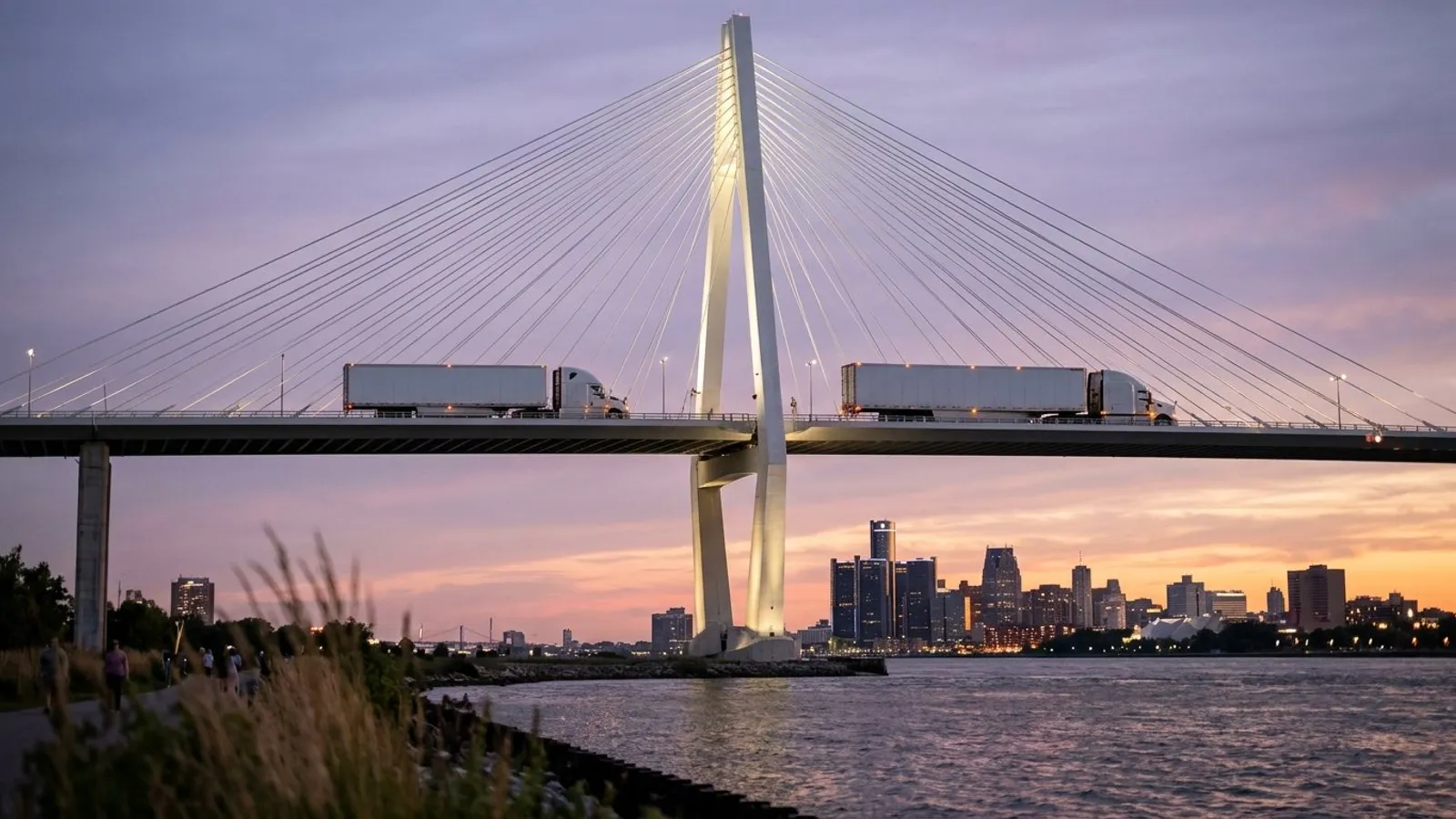
Truckers heading from Windsor to Detroit now have two bridges to pick from. The privately owned Ambassador Bridge is still open. The new Gordie Howe International Bridge opened to trucks and cars on July 27, 2026, with lower posted truck tolls and a direct freeway link. For a Brampton or GTA carrier, the right pick comes down to three things: toll cost per axle, how you reach the bridge, and whether your eManifest names the right port.
This guide walks through all three. It also covers what to do about hazmat and oversize loads, and where the Blue Water Bridge at Sarnia still fits.
Two bridges, one river, and a real choice for GTA fleets
For almost a century, the Ambassador Bridge was the only bridge between Windsor and Detroit. Big trucks can't use the Detroit–Windsor Tunnel, so if you hauled Windsor–Detroit, you paid what the Ambassador charged.
That changed this summer. Gordie Howe has six bridge lanes, 16 toll lanes and 60 Canadian and US inspection lanes, and it connects Ontario's Highway 401 directly to Michigan's I-75. Planners projected it could handle about 400 commercial vehicles an hour.
That matters a lot. Canada's ambassador to the US said at the opening that nearly 3 million trucks cross between Windsor and Detroit each year, carrying about a quarter of all Canada–US trade.
For a Brampton fleet, the run is simple. Head west on the 401, about 350 km, and pick your bridge near the end. The good news: you now have a choice at the end of that run, and choices mean better control over cost and time.
What each crossing costs a five-axle truck
Bridge tolls for trucks are charged per axle. Here is how the main options stack up for a standard five-axle tractor-trailer, as of November 2026.
| Crossing | Where it connects | Standard truck toll (5 axles, USD) | With an account (5 axles, USD) | Good to know |
|---|---|---|---|---|
| Gordie Howe International Bridge | Hwy 401 straight to I-75 | $43.75 ($8.75/axle; C$12/axle) | $34.50 with Breakaway ($6.90/axle; C$9.60/axle) | Newest crossing, freeway to freeway, on-site inspection plazas |
| Ambassador Bridge | City streets (Huron Church Road) on the Windsor side | $60 ($12/axle) | $45 or less with A-PASS ($9 or less/axle) | Private bridge; rates changed twice in 2026 |
| Blue Water Bridge (Sarnia–Port Huron) | Hwy 402 to I-94/I-69 | Check current rate | Check current rate | Busiest Ontario–Michigan truck crossing in 2025 |
The Gordie Howe rates come from the Windsor-Detroit Bridge Authority's toll announcement. Breakaway is the bridge's discount account. Business accounts came first, and charges go straight to your account at any open toll lane. Any vehicle taller than 2.3 metres (7.5 feet) pays the per-axle rate.
The Ambassador numbers come from its commercial rate sheet dated August 1, 2026, as reported by Windsor–Detroit border trackers. That's a big drop from January, when the bridge set commercial tolls at $15 per axle with an account and $20 without. Prices on a private bridge can move fast, so check the rate sheet before you quote a lane for the season.
Why trucks still line up on Huron Church Road
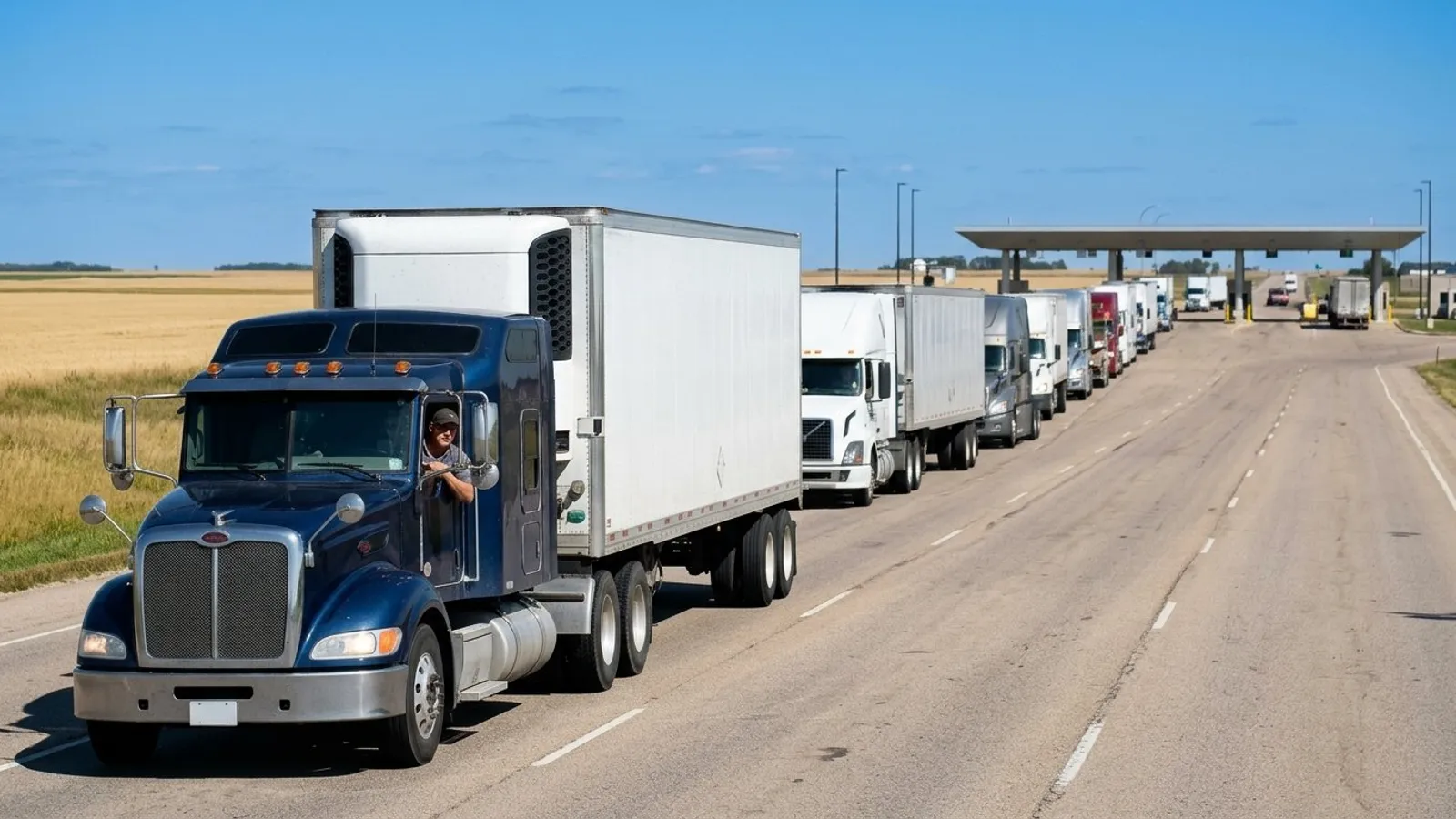
You'd expect most trucks to switch to the new bridge on day one. They didn't. In the first days after Gordie Howe opened, local news reports showed trucks still crowding Huron Church Road, the city road that leads to the Ambassador. One trucker told reporters it would ease once paperwork for trucks caught up.
That's the real lesson for your dispatch desk. Switching bridges isn't just a turn at a different exit. Your customs paperwork, your toll account and your customer's broker all have to be ready for the new port. Get those lined up once, and the cheaper crossing pays you back on every trip.
Some loads may still be better on the Ambassador. If a shipper's dock is near the Ambassador plaza, or a broker's entries are set up for it, the shorter local drive can matter more than a few dollars of toll. Make it a choice you plan, not a habit.
How to read border wait times before you dispatch
Wait times change by the hour, so check them before the driver leaves the yard and again before Windsor. Two free official sources cover it:
- Going into Canada: CBSA's border wait times page shows commercial and traveller delays at the Ambassador Bridge and links to Gordie Howe traffic updates. On the evening of November 16, 2026, it showed "No Delay" for commercial traffic at the Ambassador.
- Going into the US: CBP's Detroit Ambassador Bridge wait time page shows current and average waits, plus how many lanes are open.
Here's the catch. Each agency reports only its own direction. CBP covers trucks entering the US. CBSA covers trucks entering Canada. So a southbound GTA load needs the CBP number, and the northbound backhaul needs CBSA.
Also look at lane counts, not just minutes. A "no delay" reading at 3 a.m. with two lanes open can turn into a queue fast when the morning wave hits.
And plan for the odd bad day. In October 2025, a CBSA system outage pushed commercial waits at the Ambassador close to two hours. When that happens, the fleets that win are the ones that can re-route a driver and update the receiver in minutes, not hours.
The paperwork that has to be filed before the truck rolls
The bridge you choose changes your paperwork. Here's the checklist your dispatcher should run on every Windsor–Detroit load.
Southbound (into the US):
- ACE eManifest. ACE is the US customs electronic manifest. Under 19 CFR 123.92, CBP must receive it at least 1 hour before the truck reaches the border, or 30 minutes before for qualifying FAST shipments. The one-hour rule has applied to highway carriers since 2007.
- PAPS number. This is the shipment number your customs broker uses to clear the load. It starts with your SCAC (your four-letter carrier code). Send it to the broker early so the entry is ready when the truck arrives.
- Right port details. At opening, Gordie Howe was listed with CBSA port code 455, US port code 3801 and ACE FIRMS code H0E1. If a driver switches bridges mid-trip, update the manifest before they arrive.
Northbound (into Canada):
- ACI eManifest. ACI is Canada's version. Carriers must send it to CBSA at least 1 hour before arrival at the highway port of entry.
- PARS number. This is the Canadian release number the broker uses. Same idea as PAPS: get it to the broker before the truck rolls.
Every trip: the driver's travel documents (passport or FAST card), the bill of lading and the commercial invoice, and a working toll account for whichever bridge you're using.
Want the full breakdown of both systems? Our ACE vs ACI eManifest guide covers the data fields and common rejections.
The biggest time-waster here is re-typing. The same load data ends up in the rate con, the dispatch sheet, two manifests and the invoice. If your team keys it in four times, you get four chances for a typo that holds a truck at primary. Cross-border trucking software that builds the manifest from the load you already entered cuts that risk. TorqueAI connects with eManifest tools like BorderConnect, so the load you dispatched becomes the manifest you file.
Hazmat and oversize loads need a plan first
For decades, hazmat trucks were banned from the Ambassador Bridge and used the Detroit–Windsor Truck Ferry. That ferry closed at the end of September 2023. Soon after, Michigan was weighing a permit to let the Ambassador carry some hazmat classes, like fuel and corrosives.
Rules for each class and each bridge can differ. Before you dispatch any placarded load, confirm with the bridge operator which classes it accepts. Don't assume what was true last year still is.
For oversize and overweight loads at Gordie Howe, the bridge's guidance at opening said to get permits ahead of time and carry them in the truck, call the bridge 24 hours before arrival, and use the marked staging areas. Escort vehicles pay their own toll.
Where the Blue Water Bridge at Sarnia still fits
Don't forget Sarnia. High Ambassador tolls pushed a lot of freight north to the Blue Water Bridge. In 2025, the Blue Water Bridge carried more commercial truck trips than the Ambassador, based on bridge operator data reported by CBC News.
For GTA fleets running to Flint, Lansing, Chicago or points north and west, Sarnia via the 402 can still be the shorter, simpler run. For Detroit, Toledo, Ohio and the I-75 corridor south, Windsor usually wins. Now that Gordie Howe has lowered the Windsor toll, it's worth re-running the numbers on any lane you moved to Sarnia only because of cost.
Put the bridge into the price of every load
Here's where the new bridge turns into real money. Say your fleet makes 20 Windsor–Detroit crossings a week with five-axle trucks. Crossing at Gordie Howe on Breakaway instead of the Ambassador with no account saves $25.50 per crossing at posted rates. That's $510 a week, or more than $26,000 a year, on tolls alone.
Even against an Ambassador A-PASS account, Breakaway saves up to $10.50 a crossing. Those dollars add up fast on a tight cross-border rate.
To make that count, the toll has to be in your load cost before you say yes to the rate. Add the per-axle toll, the expected border wait and the driver's time to every cross-border quote. Fuel belongs in there too: compare this week's Ontario and Michigan diesel averages so you know which side of the river to fill up on. When you can see profit per load before you book it, picking the right bridge stops being a guess and becomes a number on the screen.
The Windsor–Detroit crossing just got more options, more lanes and lower posted tolls. Set up your toll accounts, update your port details, and teach your dispatchers to check both wait-time feeds. Do that, and your trucks spend more time rolling and less time sitting on Huron Church Road.
Questions readers ask
Can trucks use the Gordie Howe bridge now?+
Yes. The Gordie Howe International Bridge opened to commercial trucks and cars on July 27, 2026. It connects Highway 401 in Windsor directly to I-75 in Detroit, so trucks skip the city streets that lead to the Ambassador Bridge.
How much does it cost a truck to cross the Ambassador Bridge?+
As of November 2026, published rate sheets show US$12 per axle without an account, or US$9 or less per axle with an A-PASS account. That's US$60 or less for a five-axle truck. The Ambassador Bridge is privately owned and has changed its rates more than once this year, so check the current sheet before you quote a load.
Which is cheaper for trucks, Gordie Howe or the Ambassador Bridge?+
At posted rates, Gordie Howe is cheaper. A five-axle truck pays US$43.75 at the standard rate, or US$34.50 with a Breakaway account. At the Ambassador, that same truck pays US$45 or less with an account and US$60 without one.
How early do I need to send an ACE eManifest before crossing at Detroit?+
CBP must get your ACE eManifest at least 1 hour before the truck reaches the first US port. For shipments that qualify for FAST, it's 30 minutes. If your driver switches bridges, make sure the port details on the manifest match where the truck actually crosses.
Where can I check Windsor–Detroit truck wait times?+
CBSA posts commercial wait times for trucks coming into Canada at the Ambassador and Gordie Howe bridges. CBP posts wait times for trucks going into the US, including lane counts. Check both before dispatch, because each agency only reports its own direction.