Provincial hours of service in Canada: when Ontario, BC or Alberta rules apply
Your carrier's status, not today's trip, decides which hours-of-service rulebook your drivers follow. Here's how Ontario, BC and Alberta compare with the federal rules.

Key points
- Provincial HOS only applies if your carrier runs solely inside one province. Cross a border and federal rules cover your drivers.
- Ontario matches the federal daily limits: 13 hours driving, no driving after 14 on duty, 10 hours off per day.
- Alberta's provincial rule allows 13 hours driving and no driving after 15 consecutive hours on duty, with 8 hours off.
- Ontario and BC require ELDs for most in-province fleets. Alberta's provincial carriers don't need ELDs as of November 2026.
If your trucking company runs only inside one province, that province's hours of service (HOS) rules usually apply instead of the federal ones. Once any of your regulated trucks crosses a provincial, territorial or US border, your carrier is federally regulated and the federal rules cover your drivers. Ontario, BC and Alberta each have their own regulation, and the differences are real enough to matter on a driver's log.
The good news? The test is simple once you know it, and the rules for each province fit on one page. Let's walk through it.
The one question that decides your rulebook
Here's the question to ask: does my carrier operate outside this province, or only inside it?
The federal Commercial Vehicle Drivers Hours of Service Regulations (SOR/2005-313) apply to "motor carriers," which the rules define as companies running an extra-provincial truck or bus undertaking. In plain English: a company that hauls across provincial or national borders.
The key detail is that this is about your company, not one trip. Alberta spells it out clearly in its hours of service FAQ: if a carrier is federally regulated, it must follow federal hours of service laws, and that applies to all regulated drivers, even those that operate solely within Alberta.
So picture a Calgary carrier with 12 trucks. Ten run local, two run to Saskatoon. That whole carrier is on federal HOS, including the ten trucks that never leave Alberta.
Provincial rules kick in for carriers whose regulated trucks all stay home. Each province then sets its own limits, weight thresholds and logbook rules. If you need a refresher on the federal side first, our US vs Canada HOS cheat sheet lays out every federal number.
Federal vs provincial HOS at a glance
Here's how the three provinces compare with the federal rules, as of November 2026. Where a cell says "check the regulation," we couldn't confirm the number from an official source, so we left it out rather than guess.
| Federal (SOR/2005-313) | Ontario (O. Reg. 555/06) | British Columbia (MVAR Division 37) | Alberta (AR 317/2002) | |
|---|---|---|---|---|
| Who it covers | Carriers that cross provincial or national borders, vehicles over 4,500 kg | Commercial trucks over 4,500 kg | BC carriers under BC's National Safety Code program | Alberta-only carriers, trucks registered at 11,794 kg or more |
| Max driving | 13 hours in a day | 13 hours in a day | 13 hours (same daily baseline as federal) | 13 hours in a work shift |
| On-duty cutoff | No driving after 14 hours on duty in a day | No driving after 14 hours on duty in a day | 14 hours (same daily baseline as federal) | No driving after 15 consecutive hours on duty |
| Off-duty minimum | 10 hours in a day | 10 hours in a day, plus 24 hours in a row in any 14 days | Check the regulation | 8 consecutive hours before a shift |
| ELD for in-province trucks? | Required for federal carriers | Yes, since June 12, 2022 | Yes, since August 1, 2023 (some exemptions) | No, not for provincial carriers |
Two things jump out. Alberta gives provincial drivers a longer on-duty window but less rest. And Alberta is the only one of the three where an in-province fleet can still skip the ELD.
Ontario: federal-style limits and ELDs for nearly everyone
Ontario's rules live in Ontario Regulation 555/06 under the Highway Traffic Act. According to the MTO's Official Truck Handbook, they cover commercial motor vehicles with a gross or registered gross weight over 4,500 kg.
The daily rules line up with the federal ones:
- 10 hours off duty in a day
- No more than 13 hours driving in a day
- No driving after 14 hours on duty in a day
- At least 24 consecutive hours off duty in any 14-day period
Because the numbers match, a GTA fleet that's provincial today can go federal tomorrow without retraining drivers on new daily limits. That's handy when you land your first Buffalo or Montreal customer.
The bigger Ontario story is ELDs. Ontario now requires certified ELDs for trucks that operate only within Ontario, as of June 12, 2022, if those drivers were already required to keep a daily log. Penalties started January 1, 2023, and the MTO's ELD page says this applies to vehicles with plates from Ontario or any other jurisdiction. A 2023 fact sheet from the Ontario Federation of Agriculture listed fines from $250 to $20,000 for not meeting the ELD rules.
The takeaway for Ontario fleets: in-province or not, if your drivers keep logs, plan on an ELD.
British Columbia: Division 37 and a provincial ELD mandate
BC's hours of service rules are in Division 37 of the Motor Vehicle Act Regulations. BC enforces HOS violations under Division 37 for drivers on BC roads, and carriers must monitor every driver's compliance.
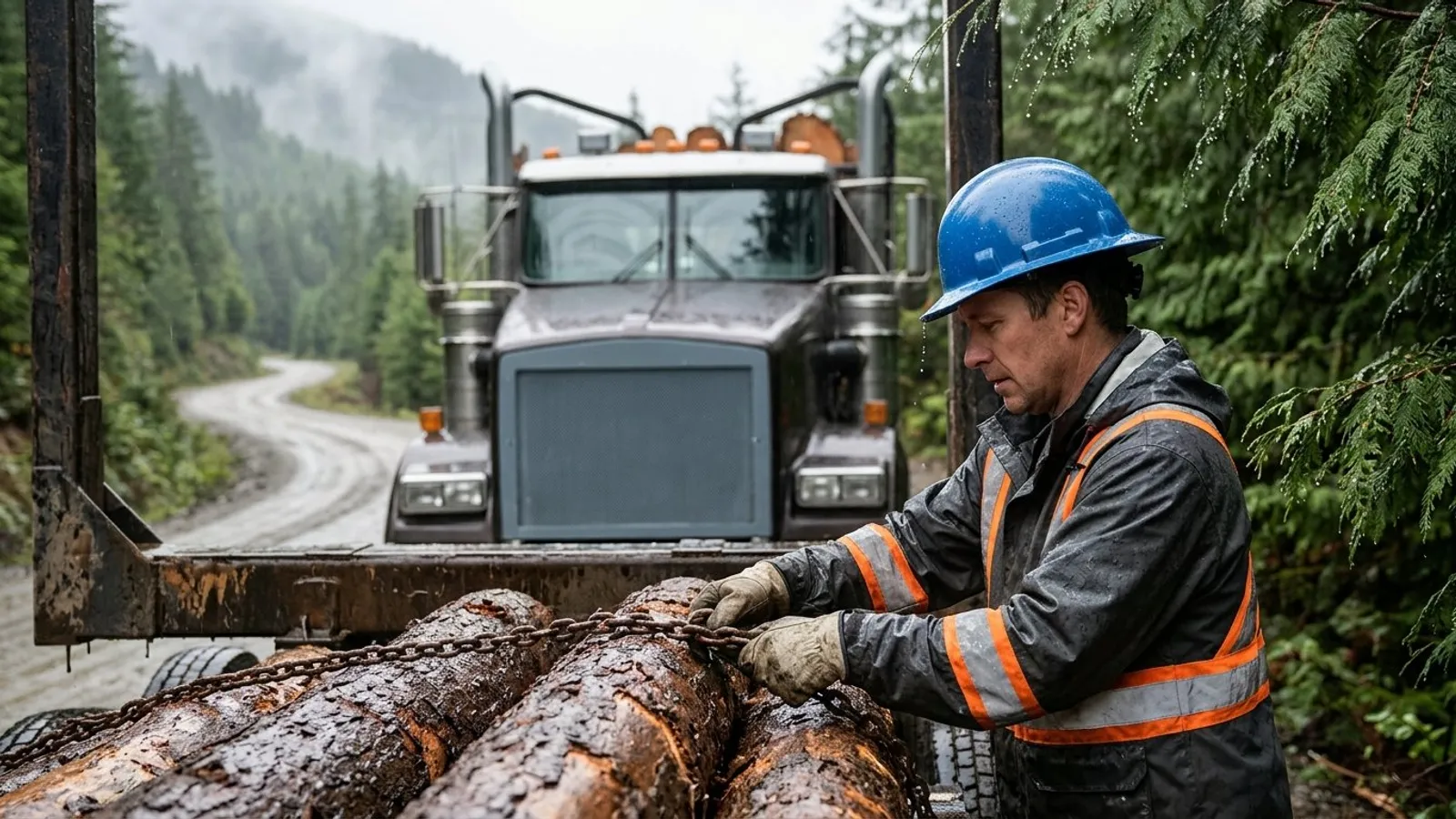
For daily limits, BC uses the same 13-hour driving and 14-hour on-duty baseline as the federal rules. Division 37 is also built around the same pieces you know from the federal side: cycles, cycle switching, ELD records of duty status, and inspections. It also has BC-specific sections, like special hours for logging trucks. If you haul logs or run oilfield work in the northeast, read those sections closely.
On ELDs, BC moved on August 1, 2023. That's when an amendment to Division 37 put in place a provincial ELD mandate that generally mirrors the federal one. Commercial Vehicle Safety and Enforcement (CVSE) issued some limited exemptions, including drivers working under BC's local driving hours rules (MVAR 37.28).
One catch: an ELD exemption is not an HOS exemption. CVSE is clear that these drivers still must record their hours, either with records of duty status or, where it applies, a local time record.
For Lower Mainland fleets running port, yard or local delivery work, that local-hours option is worth a look. For everyone else, assume an ELD.
Alberta: 13 hours driving, 15 on duty, and no ELD mandate yet
Alberta is where provincial rules differ the most. The Drivers' Hours of Service Regulation (AR 317/2002) applies to carriers that operate only within Alberta, with vehicles registered for 11,794 kg or more.
That weight line is important. Alberta's own hours of service page uses 11,794 kg for provincial carriers, while federal rules kick in above 4,500 kg. A lighter straight truck that never leaves Alberta can fall outside the provincial HOS rule entirely.
For trucks that are covered, a provincial driver:
- Can't drive more than 13 hours in a work shift
- Can't drive after being on duty for 15 or more consecutive hours
- Needs at least 8 consecutive hours off duty before a shift
Notice Alberta talks about a "work shift," not a calendar day. There's also a reduced-rest option: if the last shift was 15 hours or less, the break before the next shift can drop to as little as 4 hours, as long as the break after that next shift makes up the difference. Alberta's training material also allows up to 2 extra hours in adverse driving conditions.
Short-haul drivers have a bonus. If they stay within a 160 km radius of their home terminal and meet the other conditions, they can keep radius records instead of a full daily log.
On ELDs, Alberta says carriers that operate only in Alberta and are not federally regulated don't need to install and use ELDs "at this time." Its ELD exemption list includes all provincially regulated carriers. Federally regulated carriers driving in Alberta still need them.
Where mixed fleets get caught
Most HOS slip-ups in provincial fleets come from one of these moments:
- The first out-of-province load. An Edmonton fleet takes one load to Saskatchewan. Now it's operating extra-provincially, and the federal rules (and federal ELD mandate) apply to its drivers. Sort your operating status out before the truck leaves.
- Mixing Alberta and federal habits. A driver used to Alberta's 15-hour on-duty window joins a federal carrier, where the cutoff is 14. That one hour is an easy violation.
- Assuming "local" means "no logs." Radius and local-hours exemptions come with conditions. Miss one condition on one day and that driver needs a full log for the whole day.
- Cycle confusion. Federal drivers pick between cycle 1 and cycle 2. Our guide to cycle 1 vs cycle 2 shows which one fits your lanes.
How to check which rules your trucks run under
Here's a quick five-step check you can do this week:
- Pull your safety certificate or registration. In Alberta, look at your Safety Fitness Certificate operating status (Provincial or Federal). In Ontario, check your CVOR. In BC, check your NSC record.
- List every lane you ran in the last 90 days. Any trip across a provincial or national border means you're running an extra-provincial operation.
- Check each truck's registered weight against the province's threshold (4,500 kg in Ontario, 11,794 kg for Alberta provincial HOS).
- Confirm the ELD rule for your province and status using the table above.
- Write it down for dispatch. Every dispatcher should know which rulebook each driver runs under before assigning a load.
Want the full federal off-duty rules, including the 2-hour deferral? Read Canada's HOS off-duty rules explained.
Keeping two rulebooks straight in one office
If you run both provincial and federal drivers, or you're about to grow from one to the other, the hard part isn't learning the rules. It's making sure dispatch sees driver hours before a load goes out, not after an inspection.
That's where your ELD data needs to sit next to your loads. TorqueAI connects with the ELD providers fleets already use, so HOS data lives in the same system as dispatch, billing and driver pay. Your dispatchers plan around real hours, and your drivers stay legal.
Rules change, so check the regulation for your province before you change how your drivers log. The table above is accurate as of November 2026.
Questions readers ask
Do provincial or federal hours of service apply to my trucks in Canada?+
It depends on your carrier's status. If your company runs trucks across a provincial, territorial or national border, you are federally regulated and the federal Commercial Vehicle Drivers Hours of Service Regulations apply. If every regulated truck stays inside one province, that province's rules apply. Alberta says federal rules cover all of a federal carrier's drivers, even ones who never leave Alberta.
What are the hours of service rules in Ontario?+
Ontario's rules are in Ontario Regulation 555/06 and cover trucks over 4,500 kg. A driver needs 10 hours off duty in a day, can't drive more than 13 hours in a day, and can't drive after 14 hours on duty. Drivers also need at least 24 hours off in a row in any 14-day period.
Do Alberta-only trucking companies need an ELD?+
No, not as of November 2026. Alberta says carriers that operate only in Alberta and are not federally regulated don't need to install and use ELDs at this time. They still need daily logs, on paper or electronic, unless they qualify for the 160 km radius exemption.
Do BC trucks that stay in British Columbia need an ELD?+
Most do. BC started a provincial ELD mandate on August 1, 2023 that generally mirrors the federal one. There are limited exemptions, such as drivers working under BC's local driving hours rules, but those drivers still have to record their hours.
What is Alberta's 15-hour rule for truck drivers?+
Under Alberta's Drivers' Hours of Service Regulation, a provincial driver can't drive after being on duty for 15 or more consecutive hours, and can't exceed 13 hours of driving in a work shift. Drivers need at least 8 consecutive hours off before a new shift. This applies only to Alberta-only carriers with trucks registered at 11,794 kg or more.