How to invoice a trucking load the same day it delivers, and why it pays
Your payment clock starts when a complete invoice lands, not when the truck unloads, so here's how to send it before your driver's next pickup.

Key points
- Payment terms count from when your invoice arrives, so every day you wait to bill is a day added to getting paid.
- A same-day packet needs the signed rate con, BOL, clean POD, and receipts for lumpers or detention.
- If your fleet bills $25,000 a week, a 7-day billing lag keeps about $25,000 of earned money stuck.
- Most same-day misses come from blurry PODs, missing proof for extra charges, and PODs lost in group chats.
To invoice a trucking load the same day it delivers, get a clear, signed proof of delivery (POD) from the driver at the dock. Then check it against the rate confirmation and send the full packet to the broker, shipper or factoring company within a few hours. Sending the invoice is what starts your payment terms, so every day you wait to send it adds a day to getting paid.
That's the whole idea. The rest of this article shows how to make it happen on a normal Tuesday, with real drivers, real docks and real paperwork.
The payment clock starts when your invoice lands
Most carriers think of payment terms as "30 days after delivery." In practice, it's usually 30 days after the payer gets a complete invoice.
Federal rules work the same way. Under 49 CFR 377.203, when a for-hire carrier gives a shipper credit, the default credit period is 15 days. It starts the day after the freight bill is presented. A carrier can publish longer terms, but they can't go past 30 calendar days. Broker loads mostly run on whatever your rate con and broker-carrier agreement say, which is often net 30. Either way, the clock doesn't start until you send the invoice.
Meanwhile, your costs keep running. The American Transportation Research Institute (ATRI) found that the average cost to run a truck in 2025 was $2.336 per mile, a record high. On a 500-mile load, that's about $1,168 in fuel, driver pay, insurance and truck costs you've already spent before a single dollar comes back. Billing the same day means you carry those costs for fewer days.
What a few days of billing lag really costs
Here's a simple example. The numbers are made up, but the math works for any fleet.
Say you run 5 trucks and each one grosses about $5,000 a week. That's $25,000 a week, or roughly $3,570 a day.
- If your loads wait 7 days on average before they're billed (chasing PODs, Friday batch billing, a lost lumper receipt), about $25,000 you've already earned is sitting unbilled at any moment.
- Cut that lag to same day, and that $25,000 turns into cash about a week sooner. You don't earn more per load. You just stop lending your money to brokers for free.
That one-time cash boost can decide whether you pay for a repair from your bank account or put it on a high-interest card. It also means your factor or bank sees steady, predictable billing, which helps when you want to add a truck.
The same-day invoice packet
Before you speed anything up, know exactly what "complete" means. If a packet bounces back for a missing page, you have to resend it, and your payment terms start over from the new date. Here's what most brokers and shippers want, and where things usually go wrong.
| Document | Why the payer wants it | Common reason it bounces | Same-day fix |
|---|---|---|---|
| Signed rate confirmation | Proves the agreed rate and terms | Rate on invoice doesn't match the rate con | Enter the load from the rate con once, and bill from that same record |
| Bill of lading (BOL) | Shows what was picked up, piece count, weight | Missing pages or wrong BOL number | Driver photographs every page at pickup |
| Proof of delivery (POD) | Shows the receiver signed for the freight | Blurry, cut off, unsigned or undated | Driver checks the photo before leaving the dock |
| Lumper receipt | Backs up the unloading charge you're passing on | Receipt lost or never sent | Driver uploads it right after paying |
| Detention proof | Backs up waiting-time charges | No in and out times on the paperwork | Get times written on the BOL or POD, plus GPS or ELD records |
| The invoice itself | It's what the payer's system actually processes | Missing the broker's load number or PO | Save each customer's required fields so they print every time |
Every broker has its own setup packet with its own rules. Some want all the PDFs in one file. Some want everything uploaded to a portal. Write those rules down once for each customer, so nobody has to remember them at 6 p.m.
Before the truck rolls: set the load up to bill itself
Same-day billing starts before pickup, not after delivery.
Enter the load once, from the rate con. The rate, load number, PO, pickup and delivery details and any agreed extras go in when you book the load. If billing has to retype the load later, you've added a step and a chance for a typo.
Flag the extras up front. If the rate con says detention pays after 2 free hours, or mentions a lumper or a TONU fee (truck ordered, not used), note it on the load. When the driver arrives, everyone knows what proof to collect. Our guide on detention time and how to actually get paid for it walks through what to capture.
Tell the driver what the receiver needs. Some receivers need a seal number on the POD. Some want the driver to note shortages or damage (called OS&D: over, short and damaged). A one-line note in the dispatch message saves you a rejected packet later.
At the dock: the driver's five-minute job
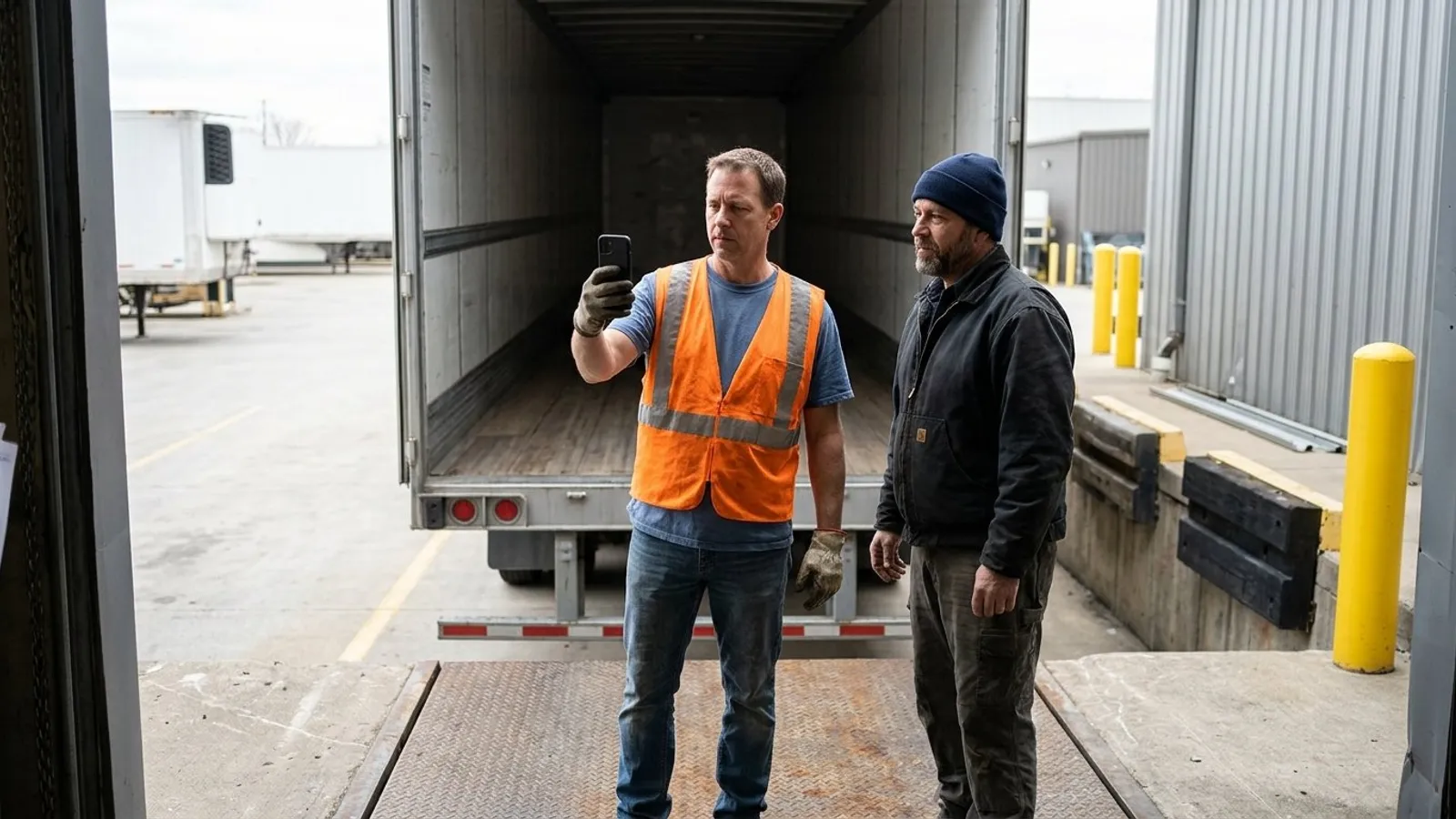
This is where most same-day invoices are won or lost. Your driver has just unloaded and wants to get rolling. Keep their part short and clear:
- Photograph the POD flat, in good light, with all four corners showing. One photo per page.
- Check it before leaving. Is there a signature? A printed name? A date? Any notes about shortages or damage?
- Upload it right away, not at the end of the shift. Add lumper receipts and scale tickets in the same step.
- Log arrival and departure times if there was any wait.
- Send a quick "delivered, docs uploaded" message so dispatch can line up the next load.
Where this breaks down most often is the group chat. A POD sent on WhatsApp gets buried under 40 other messages, saved on someone's personal phone or sent as a blurry thumbnail. Then billing spends 20 minutes scrolling and texting the driver back. If that sounds familiar, here's why fleets replace WhatsApp for dispatch with messaging tied to each load.
This is exactly the job TorqueAI Driver was built for. The app walks drivers through PODs, receipts and trip sheets step by step. The documents land on the right load in the office automatically, so nobody has to chase them.
Back at the office: POD to invoice in under an hour
Once the POD reaches the office, checking it should take minutes, not days:
- Match the POD to the load. Right load number, right receiver, right date.
- Compare the rate. The invoice should match the rate con to the penny, plus any approved extras.
- Add the extra charges with proof. This covers detention, lumper fees, layovers and extra stops. If you have no proof, you won't get paid for it.
- Build one clean file. Put the invoice first, then the rate con, BOL, POD and receipts, in the order the payer asks for.
- Send it the way the payer wants it: by email, through their portal or straight to your factoring company.
- Set the due date so you know exactly when to follow up.
If you have more than one dispatcher, give one person clear ownership of the "delivered but not invoiced" list. That list should be empty by the end of each day. Treat it like a warning light on the dash: when something shows up on it, deal with it today.
For a deeper look at automating this step without losing control of what goes out, read Freight Billing: How to Automate Invoicing and PODs.
Where same-day billing usually breaks
Most fleets don't miss same-day billing because of one big problem. It's a handful of small ones:
- Friday batch billing. A load delivered Monday waits four days for no reason. Bill every day instead.
- Blurry or partial PODs. Fix it at the dock with a quick photo check.
- Rate changes that never made it into the system. A broker agrees to $200 more on the phone, but there's no updated rate con. Get it in writing before you invoice.
- Extra charges with no backup. If you can't prove the wait, you'll probably have to absorb the cost.
- Documents spread across five places. Email, texts, a shared drive and a paper folder in the truck. Giving each load one home for its paperwork fixes most of this.
Factoring, quick pay or net 30: same day still wins
Same-day invoicing helps no matter how you get paid.
Net 30 direct. Billing on the day of delivery means your 30 days start right away. If you bill a week late, you're really on net 37.
Quick pay. Many brokers will pay faster if you let them take a fee off the load. It can help in a tight week, but the broker still needs a complete packet first.
Factoring. A factoring company buys your invoice and pays you most of it upfront, for a fee. Factors still check every packet before they pay, so a missing POD slows you down there too. Plenty of small fleets keep fuel money in the account by billing the same day and factoring their invoices.
If you're weighing these options, our guide on how to get paid faster in trucking compares them side by side.
Canadian carriers: put the right tax info on the invoice
If you haul in Canada, a complete invoice also needs the right GST/HST details. Your customer needs them to claim input tax credits (ITCs), which is how a business gets back the GST/HST it paid on its costs. For sales of $500 or more, the CRA's input tax credit rules expect your business name, your GST/HST registration number, the invoice date, the tax charged, the buyer's name, the payment terms and a description of the service.
Almost every truckload invoice is over $500, so build these fields into your invoice template once. If a shipper's accounts payable team has to ask for your GST number, that shipper will pay you later.
Keep the paper trail for disputes
Billing the same day also gives you a clean record when a payment goes wrong.
- Store every packet by load. The IRS generally suggests businesses keep records for three years, and some records longer. Digital files tied to each load are much easier to find than a box in the shop.
- Know your rights on broker loads. Under 49 CFR 371.3, each party to a brokered load has the right to review the broker's record of that load. As of late August 2026, FMCSA had sent its proposed broker transparency rule to the White House for review, and the current rule still stands as written until a final rule takes effect.
- Track short pays. A short pay is a payment that comes in under the invoice amount. Flag it the same week, while the details are fresh.
The goal is simple. When a load delivers, the invoice goes out before the truck reaches its next pickup. Do that every day and you'll feel it in your bank account within a month.
Questions readers ask
Can I invoice a trucking load the same day it delivers?+
Yes. If the rate con is already in your system and the driver sends a clear, signed POD at the dock, you can check it and send the invoice within an hour or two. What usually stops same-day billing is missing or messy paperwork, not the invoice itself.
What documents do I need to invoice a broker for a load?+
Most brokers want the signed rate confirmation, the bill of lading and a signed proof of delivery. If you're billing extras, add the lumper receipt, your detention in and out times, or scale tickets. Check each broker's setup packet, because some also want their load number or PO number on the invoice.
When does net 30 start for a trucking invoice?+
Net 30 usually counts from the day the broker or shipper gets your complete invoice and paperwork, not from the delivery date. That's why billing three days late usually means getting paid three days late. Read your broker-carrier agreement to see exactly how your terms are worded.
Is factoring faster than invoicing the broker myself?+
Factoring gets you cash sooner than waiting out net 30, but you pay a fee and the factor still needs a complete, clean packet before it pays you. Same-day invoicing helps either way. It gets money moving sooner whether you bill the broker directly or send the load to your factor.
What should a Canadian carrier put on an invoice for GST/HST?+
For sales of $500 or more, the CRA expects your business name, your GST/HST number, the invoice date, the tax charged, the customer's name, the payment terms and a description of the service. If any of these are missing, payment can slow down, because your customer needs them to claim input tax credits.