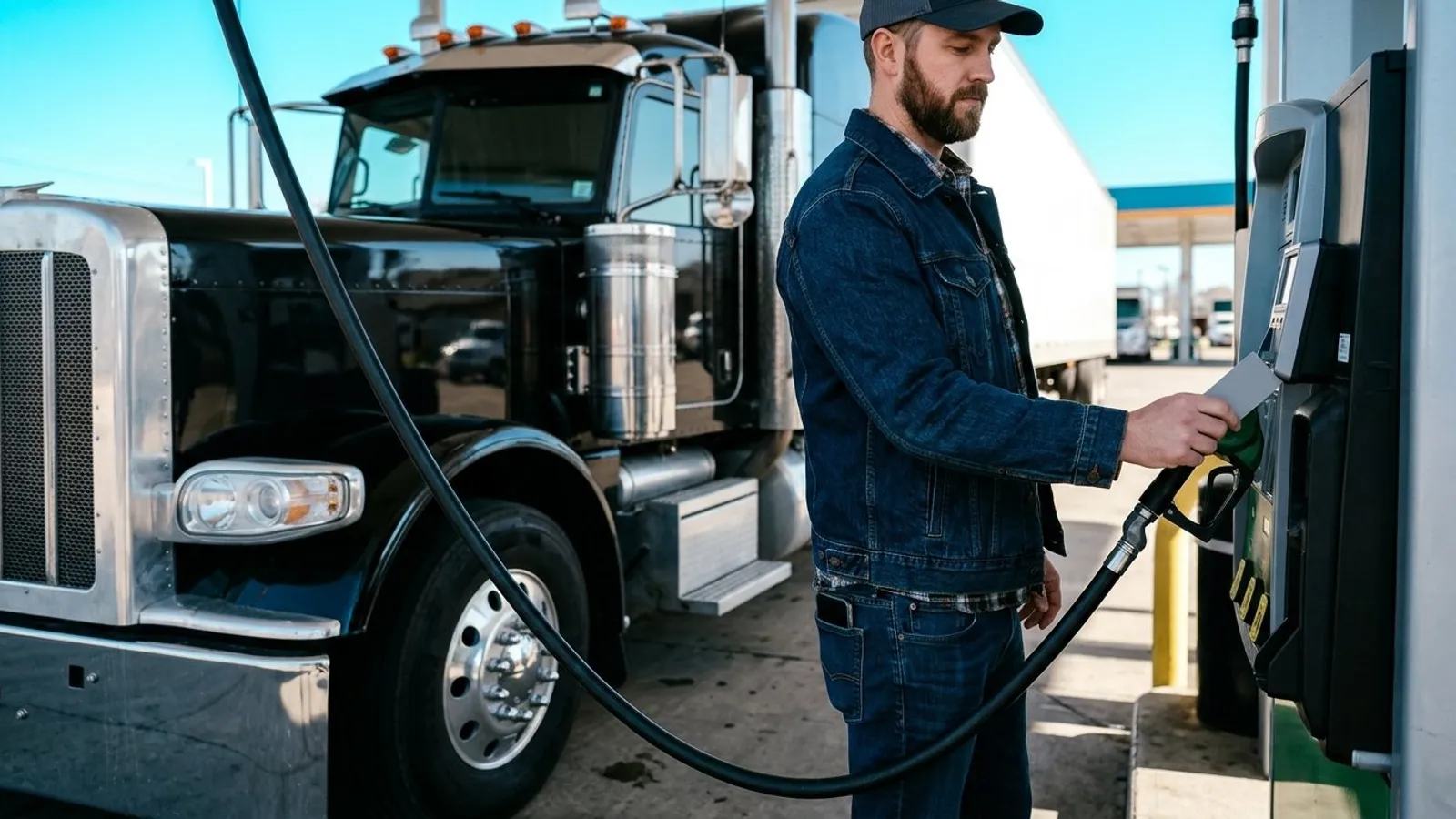
Fuel cards for small fleets: what to compare before you sign
With diesel above $6 a gallon, the wrong fuel card can quietly cost one truck thousands a year. Here's how to check the discount, fees and controls.


Key points
- U.S. diesel averaged $6.29 a gallon the week of Nov. 2, 2026, per EIA data, so every cent off matters.
- Compare net savings per gallon after all fees, not the headline discount. Reprice your last 90 days of fuel stops.
- Set controls by driver and truck: diesel-only, gallon caps, unit number and odometer prompts, and instant card lock.
- IFTA needs date, seller, gallons, fuel type, price, truck ID and buyer name on every receipt, kept for four years.
The best fuel card for a small trucking company is the one that saves you the most per gallon at the stops your trucks actually use, after every fee is taken out. It should also give you tight controls over what each driver can buy, and send clean data to your IFTA report and your books. Before you sign, compare five things: how the discount is worked out, where the card is accepted, the full fee list, the controls, and where the data goes.
If you're still paying full pump price, or your current card lets any driver buy anything anywhere, this is money leaving your company every week.
Why the card you pick matters more at $6 diesel
As of November 2026, diesel is expensive. The U.S. average retail diesel price was $6.292 a gallon for the week ending Nov. 2, according to EIA data published by the St. Louis Fed. In Canada, Natural Resources Canada's daily average was about $2.60 a litre on the same day.
Fuel was already a big piece of your cost per mile before this spike. The American Transportation Research Institute's 2026 Analysis of the Operational Costs of Trucking put the average cost to run a truck in 2025 at $2.336 a mile, or $1.854 a mile without fuel. That means fuel alone was about 48 cents a mile, and that was at lower prices than you're paying now.
Here's what that looks like for one truck:
- 120,000 miles a year at 6.5 miles per gallon = about 18,500 gallons
- At $6.29 a gallon, that's roughly $116,000 in fuel
- Save 10 cents a gallon: about $1,850 a year
- Save 30 cents a gallon: about $5,500 a year
Multiply that by your trucks. For a lot of small fleets, picking a fuel card takes about 30 minutes, and it's still one of the biggest cost decisions you'll make all year.
How fuel card discounts actually work
The number on the sales sheet is rarely the number you get. Discounts are priced in a few different ways, and you need to know which one you're signing up for.
Discount off the pump price (retail-minus). You get a set number of cents off the posted price. Simple to understand, but the pump price at some stops is already high, so "40 cents off" might still cost more than a cheaper stop down the road.
Cost-plus pricing. You pay roughly what the truck stop paid for the fuel, plus a markup. This can beat retail-minus when prices swing, but only if you trust how the "cost" is figured. Ask how often it's updated and whether you can see it.
Rebates on your statement. The discount doesn't show at the pump. It comes back later as a credit. That's fine, but it makes it hard for drivers and dispatchers to know which stop is really cheapest when they plan fuel.
In-network only. Many discounts only apply at certain chains or locations. Fuel outside the network and you may pay full price plus a fee.
Ask every provider the same questions: Discount off what price? At which stops? Shown at the pump or on the statement? Does it change with my gallons each month?
The fees that eat your discount
A card with a big discount and a pile of fees can lose to a smaller discount with no fees. Look for:
- Monthly program fees or per-card fees
- Per-transaction fees
- Out-of-network fees
- Cash advance fees (if drivers pull cash for lumpers or repairs)
- Late payment fees and short pay terms
- Minimum monthly gallons to keep your discount tier
- Paper statement or extra reporting fees
- Currency conversion fees if your trucks fuel in both the U.S. and Canada
Get the full fee schedule in writing. Then work out your net savings per gallon: total discount minus total fees, divided by total gallons. That one number is what you compare.
The checklist: what to compare before you sign
| What to compare | What to ask the provider | Red flag |
|---|---|---|
| Discount type | Retail-minus, cost-plus or rebate? Shown at the pump? | Can't explain how the price is set |
| Network fit | Does it cover the stops on my top lanes? | Discount only at stops you rarely use |
| Fees | Can I see every fee in writing? | "We'll go over fees after you sign up" |
| Credit and billing | Credit line size, billing cycle, payment terms | Weekly pay terms you can't meet while waiting on brokers |
| Controls | Can I set limits by driver and by truck? | One setting for the whole fleet |
| Prompts | Does it require PIN, unit number and odometer? | No unit number on transactions |
| Alerts and lock | Real-time alerts? Lock a card from my phone? | Must call during office hours to cancel |
| Data | Can I export or connect transactions to my TMS and accounting? | PDF statements only |
| Cross-border | Works in both countries? Litres and gallons? FX fees? | Hidden conversion markup |
| Contract | Length, cancel terms, minimum gallons | Long term with penalty to leave |
Controls that stop fuel from walking away
Weak controls are how fuel money disappears. A driver fills a personal pickup. A card gets skimmed and someone runs it at three stops in one night. Snacks and phone chargers end up on the fuel bill. None of it is huge on its own, but it adds up, and you often don't see it until the statement shows up.
Good controls let you set rules per card, per driver and per truck:
- Product limits. Diesel only. Allow DEF or reefer fuel only on the trucks that need it.
- Gallon limits. Cap each fill-up near the truck's tank size, and set a daily cap.
- Location limits. Block states or provinces your trucks never run in, if the card allows it.
- Driver ID and prompts. Require a PIN, plus the unit number and odometer reading at the pump.
- Real-time alerts. Get a text when a purchase breaks a rule or looks odd.
- Instant lock. Shut off a card from your phone at 2am without calling anyone.
One more check that catches a lot: compare fuel stops against where the truck actually was. If your ELD shows the truck parked in a yard while its card was used 200 miles away, you have your answer.
What IFTA needs from every fuel purchase
IFTA is the fuel tax report you file every quarter. It splits your miles and fuel by state and province so each one gets its share of fuel tax. Your fuel card data is a big part of that return, so make sure the card gives you what auditors want.
Under section P550 of the IFTA Procedures Manual, a credit card receipt or a transaction listing from a third party counts as proof of fuel bought. To get credit for tax you already paid at the pump, each record needs:
- Date of purchase
- Seller's name and address (a clear vendor code is OK)
- Gallons or litres bought
- Type of fuel
- Price per gallon or litre, or the total price
- The truck the fuel went into
- The buyer's name
That "truck the fuel went into" line is why the unit number prompt matters. A card that doesn't capture it leaves you rebuilding records by hand, or losing credits in an audit.
Keep those records. The Iowa DOT says carriers generally must hold fuel and distance records for four years after the return was due or filed, whichever is later. Ohio's tax department warns that missing records can mean lost fuel tax credits plus extra tax, penalties and interest.
Also watch what goes on the return. Colorado's IFTA guidance notes that DEF isn't fuel and reefer fuel is left out of your IFTA gallons. A card that shows diesel, DEF and reefer fuel as separate line items saves you from sorting them later. For dates and common filing mistakes, see our guide to IFTA filing deadlines.
Where the fuel data goes after the pump
This is the part most owners skip, and it's where the hours go. The card company emails a statement. Someone downloads it, types fuel into QuickBooks, copies gallons into an IFTA spreadsheet, and works out which fuel to take off which driver's pay. Every week. Every truck.
Before you sign, ask how the transactions get out of the card's portal. A CSV download is the bare minimum. A direct connection to your TMS is better, because each purchase lands on the right truck, the right load and the right driver settlement without anyone retyping it. You can check which fuel cards connect on our integrations page.
TorqueAI connects with many major fuel cards, so fuel-related accounting happens on its own and each purchase shows up in your cost per truck and profit per load. If you pay drivers who fuel on company cards or take fuel advances, the same data can feed driver pay and deductions instead of a weekly spreadsheet. It's set up for fleets from 1 truck to 500+, and works differently based on your fleet size and where you're headquartered.
How to compare offers in one afternoon
You don't need a consultant. You need your own numbers.
- Pull your last 90 days of fuel. Every stop, every gallon, every price.
- List your top 10 stops. These are where most of your gallons go.
- Send the list to two or three card providers. Ask them to reprice those exact purchases under their program.
- Take out every fee. Use the fee schedule they gave you in writing.
- Compare net savings per gallon. Then check controls, data and contract terms using the table above.
Pick the card that wins on net savings and still gives you real control. A small discount you can trust beats a big one that comes with gaps in your IFTA records and fuel you can't account for.
Questions readers ask
What is the best fuel card for a small trucking company?+
The best card is the one that saves you the most per gallon at the truck stops your drivers already use, after every fee is taken out. It should also let you lock down what each driver can buy and send clean data to your IFTA report and your books. Ask each provider to reprice your last 90 days of real fuel stops, then compare the net numbers side by side.
How much can a fuel card save a small fleet?+
It depends on where you fuel, how many gallons you buy and how the card prices its discount. A useful rule: a truck running 120,000 miles a year at 6.5 mpg burns about 18,500 gallons, so every 10 cents a gallon you save is worth about $1,850 a year per truck. Always check the savings after fees, not before.
What fees do fuel cards charge?+
Common fees include monthly or per-card fees, transaction fees, fees for fueling outside the card's network, cash advance fees, late payment fees and charges for paper statements. Some cards also need a minimum number of gallons each month to keep your discount. Get the full fee schedule in writing before you sign.
Can I use fuel card statements for my IFTA return?+
Yes. The IFTA Procedures Manual accepts credit card receipts and transaction listings from a third party as proof of fuel bought. To get tax-paid credit, each record must show the date, seller name and address, gallons or litres, fuel type, price, the truck the fuel went into, and the buyer's name. You must keep these records for four years.
How do I stop drivers from misusing a fuel card?+
Use the card's controls. Limit purchases to diesel (and DEF or reefer fuel only if that truck needs it), cap gallons per fill-up and per day, and make drivers enter a PIN, unit number and odometer reading. Turn on real-time alerts and make sure you can lock a card from your phone in seconds.